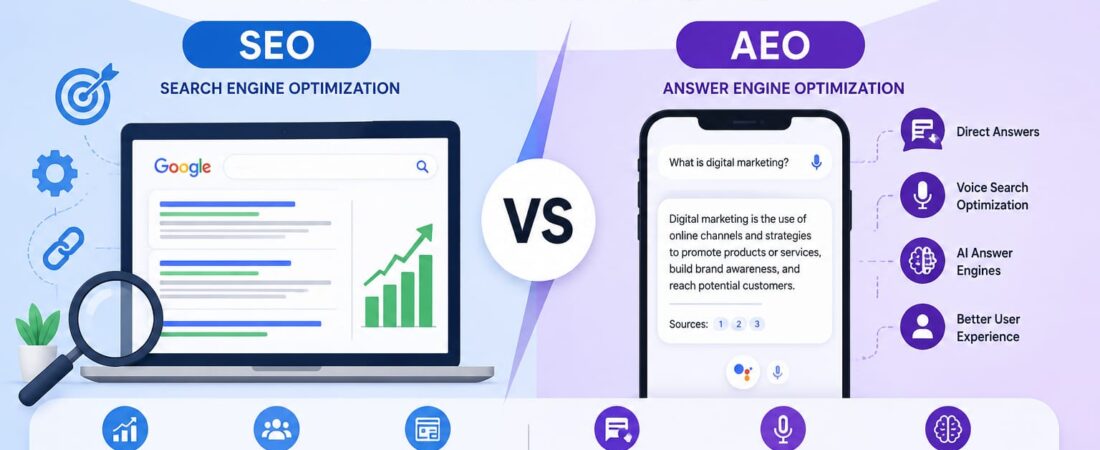
Have you ever wondered why some websites rank on Google while others appear directly in AI-generated answers?
If you’ve been writing blogs or building websites, you already know one thing: SEO is important. But now there’s a new shift happening, and it’s changing how content gets discovered online. As search technology changes, we need to understand how these methods work and when to use them.
In this SEO vs AEO guide, we will explain both concepts in simple language.
What Is SEO?
SEO (Search Engine Optimization) is what we’ve been using for years. It helps websites rank higher on search engines like Google. It helps your content show up on Google when people search for something.
In SEO, we focus on:
- Keywords
- Backlinks
- Technical structure
- Page speed
- Rankings
So basically, SEO helps your website get found.
For example, if someone searches for “best running shoes,” Google shows websites that it considers useful and relevant.
How SEO Works
SEO uses several techniques to improve rankings:
- Keyword research
- On-page optimization
- Link building
- Technical improvements
- User-friendly website design
Good SEO also includes Google Search optimization so search engines can understand and index your content properly.
What Is AEO?
AEO (Answer Engine Optimization) is the newer approach. Instead of just ranking on Google, AEO focuses on helping AI tools like:
- ChatGPT
- Google AI Overviews
- Gemini
- Perplexity
Understand your content and use it as direct answers.So now it’s not just about clicks. It’s about: “Will AI choose your content as the answer?” That’s the real shift. Today, people use voice assistants and AI-powered platforms to ask questions. Instead of clicking multiple websites, they often expect a quick answer.
How AEO Works
AEO focuses on providing direct answers to questions. It uses:
- Clear headings
- Question-based content
- Structured information
- Short and direct answers
Many websites improve their chances of appearing in featured snippets by answering common user questions clearly. AEO also supports voice search optimization because voice assistants often select concise and relevant answers.
Do We Need Both SEO and AEO?
Yes, absolutely. If we only do SEO, we might get traffic, but miss AI visibility. If we only do AEO, AI may understand our content, but no one reaches our website. So the smart approach is balance.
We should:
- Write for users (SEO intent)
- Structure for AI (AEO clarity)
How to Optimize Content for AEO
Many beginners ask how to optimize content for AEO.
You can start with these steps:
- Answer questions directly.
- Use simple language.
- Add FAQ sections.
- Organize content with clear headings.
- Write concise answers before detailed explanations.
You should also focus on search intent optimization by understanding what users really want when they search for information.
SEO and AEO Together
Some people think they must choose between SEO and AEO. In reality, both work better together. SEO helps search engines discover your content, while AEO helps answer user questions effectively. Strong content optimization supports both strategies. When you create helpful content, you improve your chances of ranking in search results and appearing in AI-generated answers. You can also strengthen your visibility through AI search optimization, which combines traditional SEO practices with modern answer-focused strategies.
Is AEO Replacing SEO?
A common question is, is AEO replacing SEO?
The simple answer is no and honestly, it’s better to think of it like this:
- We are not replacing SEO.
- We are upgrading it.
SEO is still your foundation. But AEO is what makes your content “AI-ready.” SEO helps people find you and AEO helps AI understand and recommend you. Both work together. SEO remains important because websites still need visibility in search results. AEO adds another layer by helping content appear in direct answers and AI responses. Businesses that combine both approaches often achieve better results.