by Sumaya Aziz | 15 june 2026
You’ve spent hours writing blog posts, but your pages still linger on page three of Google. Frustrating, right?
Here’s the truth: most ranking problems start with content writing mistakes you don’t even know you’re making. The good news? You can fix them.
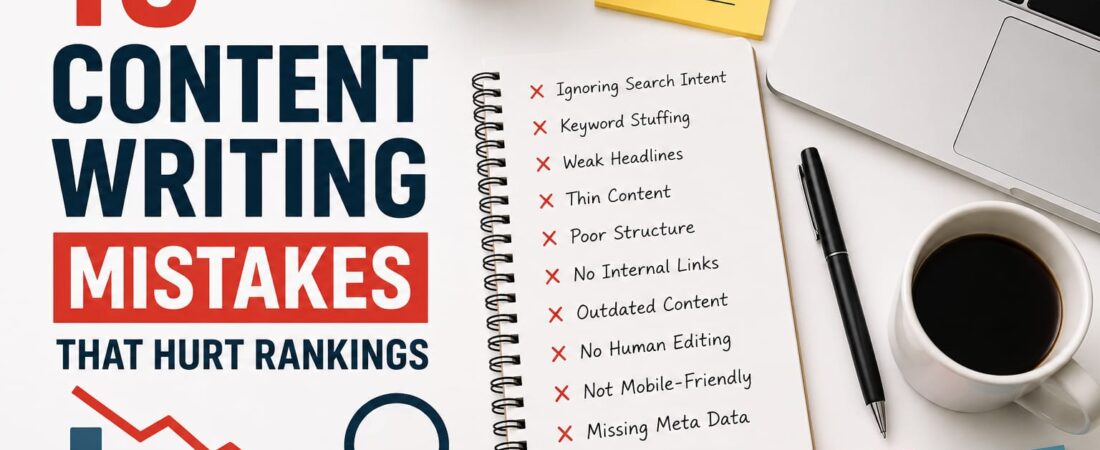
In this guide, we’ll walk you through 10 common content writing errors that silently kill your SEO. More importantly, we’ll show you exactly how to avoid them so you can create content that ranks.
Common Content Writing Mistakes That Affect SEO
Before we get specific, let’s agree on one thing: search engines reward useful, well-written content. When you make SEO content writing mistakes, you tell Google your page isn’t worth showing. That means lower rankings, less traffic, and missed opportunities.
Here are the content mistakes that hurt rankings the most, and how to fix each one.
1. Ignoring Search Intent
You write a detailed guide, but users leave within seconds. Why? Because you didn’t match what they were actually looking for.
Search intent is the why behind a query. If someone searches “best running shoes”, they want product comparisons, not a history of sneakers. When you ignore intent, Google notices the bounce rate and drops your ranking.
Learn How to Fix: Before you write, ask: What is the user really trying to do? Answer that directly in your first 100 words.
2. Keyword Stuffing
Keyword stuffing is one of the oldest blogging mistakes to avoid, yet people still do it in the era of AI. Google’s algorithms are smarter now, they treat over-optimization as a ranking penalty and use AI models to evaluate the content.
Read this post if you dont know how to find low competition keywords
Learn How to fix: Use your main keyword naturally. Once or twice in the intro, once in an H2, and a couple of times throughout. Then stop. Write for humans first.
3. Weak or Missing Headlines
Your headline is the first (and sometimes last) thing people read. A boring headline = no clicks = no ranking signal. Even great content fails if the title doesn’t grab attention.
Learn How to Fix: Use numbers, questions, or clear promises. Instead of “Content Writing Tips,” try “10 Content Writing Mistakes That Hurt Rankings.” See the difference? Keep headlines under 60 characters so they display fully in search results.
4. Publishing Thin Content
Three hundred vague words with no examples, data, or actionable advice? That’s thin content, and Google hates it. Thin pages don’t answer questions, so they don’t deserve top spots.
Learn how to Fix: Go deep. If you cover a topic, aim for 1,500+ words of real value. Add examples, screenshots, case studies, or step-by-step instructions. Be the resource you’d want to find.
If you want to improve rankings, focus on covering topics in detail. Add examples, practical tips, and relevant information that help users achieve their goals. This approach helps you avoid common content writing errors that reduce content quality.
5. Not Optimizing Meta Titles and Descriptions
Your meta title and description are your free ad in search results. Ignore them, and you leave clicks, and rankings on the table. Low click-through rates (CTR) tell Google your result isn’t relevant.
Learn How to Fix: Write a meta title under 60 characters with your primary keyword. Then craft a meta description under 160 characters that teases a benefit. Use action words like “learn,” “discover,” or “fix.”
Ignoring these elements is one of the Content mistakes that hurt rankings because lower click-through rates can impact overall SEO performance.
6. Poor Content Structure
Huge walls of text. No subheadings. Random bold words. Readers bounce in seconds and so does Google. Poor structure is one of the most overlooked content optimization mistakes.
Learn how to Fix: Break your content into short paragraphs (2–3 sentences max). Use H2s and H3s to create a clear hierarchy. Add bullet points and bold key phrases. Make it skimmable.
7. Ignoring Internal Linking
Internal links help visitors discover related content on your website. They also help search engines understand the relationship between different pages. You write a great post, but you never link to your other related pages. That’s a missed chance to pass “link juice” and guide users deeper into your site. Without internal links, search engines struggle to understand your site’s structure.
Learn How to Fix: Every time you publish, link to 2–4 relevant old posts. Use descriptive anchor text like “our guide to on-page SEO writing tips” instead of “click here.”
8. Not Updating Old Content
SEO is not a one-time task. Last year’s “ultimate guide” now has broken stats and outdated examples. Google loves freshness. When you ignore old posts, they decay in rankings while competitors update theirs.
Learn How to Fix: Every 6 months, review your top 10 posts. Update stats, add new insights, refresh links, and change the publish date. Then repromote them. It’s one of the highest-ROI search engine ranking factors you control.
9. Using AI Content Without Human Editing
AI tools are fast but they also make mistakes, repeat phrases, and sound generic. Publishing raw AI content hurts your credibility and rankings because it lacks personal experience and original insight.
Learn How to Fix: Use AI for drafts or outlines. Then you edit every sentence. Add your voice, real examples, and local knowledge. Google rewards EEAT (Experience, Expertise, Authoritativeness, Trustworthiness) AI alone can’t deliver that.
10. Neglecting Mobile Readers
Over 60% of searches happen on mobile. If your font is tiny, your buttons are close together, or your paragraphs are too wide, mobile users will leave immediately. That sends a strong negative signal to Google.
Learn How to Fix: Use a responsive theme. Set font size to at least 16px. Add plenty of white space. Test every post on your own phone before publishing.
How to Avoid Content Writing Mistakes
We’ve covered the problems. Now let’s talk about solutions. Here’s your quick checklist for SEO-friendly content writing that actually works:
- Match search intent first always asks “what does the user need?”
- Use keywords naturally — one main keyword, a few LSI terms like common content writing errors, done.
- Write headlines that promise value — and deliver on that promise.
- Go deep — 1,500+ words of helpful, original information.
- Optimize every meta title and description — treat them as ads.
- Structure for skimmers — short paragraphs, headings, lists.
- Link internally — guide users and bots to your best pages.
- Refresh old content — keep it accurate and current.
- Edit all AI content — add human stories and voice.
- Design for mobile first — test on small screens.
Read this if you are beginner in content writing field: AI content Vs human content
Conclusion
Content writing mistakes can quietly damage your rankings, but they’re also fixable. By understanding search intent, creating valuable content, and focusing on user experience, you can improve both your SEO and your readers’ trust. Small changes today can lead to better rankings and long-term growth.
If you want to learn more about content writing press the button
FAQS About Content Writing Mistakes
Q1: What is the biggest content writing mistake for SEO?
Ignoring search intent is the biggest mistake. You can have perfect grammar and keywords, but if your content doesn’t match what users actually want, Google won’t rank it. Always ask: What problem is the searcher trying to solve?
Q2: Can poor content lower Google rankings?
Absolutely. Low-quality content leads to high bounce rates, short dwell time, and few backlinks. Google interprets those signals as “this page isn’t helpful” — and your rankings drop. That’s why content optimization mistakes directly hurt your visibility.
Q3: Does AI-generated content affect SEO rankings?
It depends. Raw, unedited AI content usually ranks poorly because it lacks originality, accuracy, and personal insight. But AI-assisted content that you thoroughly edit, fact-check, and humanize can perform well. Google rewards quality not the tool behind it. Always add your own expertise.